baby birds
Wild Bird Shelly Magpie Walks Into The Cage On Request
By Gitie
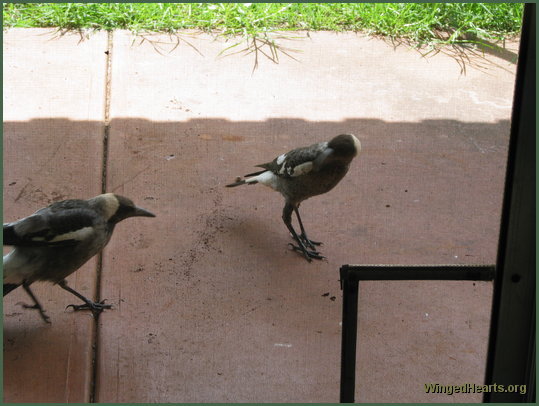
Juvi magpies - Shelly (left) with sister Nelly at our back door.
Will a wild bird (never handled or hand fed) walk into a cage just because you ask her to?
Juvi magpie Shelly injured herself on the day of the terrible storms resulting in the inland tsunami in Toowoomba and the Lockyer valley. She didn't come down with her family for two days. Due to the heavy rains we couldn't go out into the neighbouring paddocks looking for her either. We thought she may have met a tragic end in the storms, but when the rains stopped briefly on the third day Ron went scouting and found her sitting still in a paddock. Relieved to find her alive, Ron and I would go out to the fields to feed her when we could. A few days later she started to walk but after 3 weeks she still could not fly. She could only climb up tree trunks by hopping along along fallen branches that were still leaning against them as in the picture below.
read more »
Juvi Magpies Tumbling Around Like Puppies
By Gitie
Australian magpies Shelly and Nelly are about six months old. They are Vicky and Bertie's second set of kids. They love playing around are backyard, tumbling around, playing tug-o-war, pouncing on crows and bossing currawongs. Always on the alert, they are quick to chase goannas and snakes away or put out alarms of eagles soaring in the sky. read more »
Barn Swallow
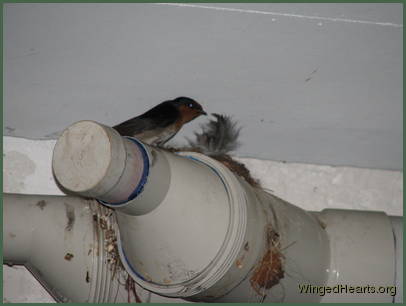
For years I thought these birds were Rufous Fantails. But Sue Laing, a reader very kindly wrote to me correctly pointing out that they are actually barn swallows.
A pair of Barn Swallows flew all the way from some shrubs across the open car park and stopped right in front of Ron one morning. They twittered, saying hello, spent a few more moments with him before returning from whence they came. I have read more »
Breaking Through The Communication Barrier With Birds
By Gitie
Purple Finches Train Novelist Resa Nelson - Part 2
By Gitie
Novelsit Resa Nelson continues her story about how the finches in her garden trained her.
The finches have been nesting on my balcony for years, and it's common to get two nests (at different times) in the same flower basket each spring. I'm always fascinated by the behavior of each family because they're so different.
It took the parents a while to train me when to go out and buy a basket (they let me know when they're ready to build a nest), as well as how I've communicated with a mother that I only want to water the plant and not harm the nest or eggs.
She was at first upset until I showed her exactly what I was doing, and then it was like watching a light bulb go off over her head and all I had to do from that point on was show the water bottle to her and she would fly off to let me water and stay calm instead of getting upset.
Novelist Resa Nelson's Baby Purple Finches - Part 1
By GitieI love your website! I've been a huge fan of birds all my life and have friends who are bird rehabilitators. Your stories about birds are charming. My readers know how much I love birds, and I'm sure they'd love to learn about your site! I have a Red-Tailed Hawk that I've befriended (by chasing away crows that were mobbing it). But what my readers know best are my stories of how Purple Finches nest on my balcony every year, just a foot from my window. In fact, I plan to post a video on YouTube of great footage I got of the babies exercising their flight muscles and nearly flying out of the nest before they were ready and will send you the details shortly.
-- Resa Nelson, Author,
'Our Lady Of The Absolute' - out now!
http://resanelson.com/september-28-special-offer/
Each year Purple Finches nest one foot from my window.
In each family, one baby takes a leadership role and does something unique.
|
In this family, the baby leader perches on the edge of the nest. Then... |
|
the perching baby exercises its flight muscles by flapping its wings. It's two siblings watch... |
|
This is something I've never seen a baby Purple Finch do before. It's stretching it's legs. |
|
Notice the tufts of baby fuzz on the birds' heads. Here it's easier to see the markings and colouring of the baby's breast.
|
|
The dominant baby has returned to the nest. One of its siblings decides to try its wings. |
|
...And the were a little more startling than expected. Tomorrow I'll post the video so you can see what happens next!
|
Claire's Baby Hawks
By GitieReader Claire Muskus sent us these gorgeous pictures of baby red-talied hawks. The chicks look so cute: here is Claire's story:
"We have a pair of red-tailed hawks that nest each year on our 5th floor ledge. Usually mid-March, the mom starts her annual ‘house cleaning’ then commences to ‘just sit’. This year there were 3 eggs; all survived. Last year the same number were in the nest, but only two survived. Several years ago, one of the ‘youngins’ fell out of a tree that was near the bldg. Because its wings weren’t strong enough to make it fly back up to the nest, it wandered back and forth on the wall with its mother was dutifully watching and calling to it from across the street and often making low sweeps over it. Some agricultural students from Trinity College were called in to try to capture it, which they were able to, somehow. I had the good fortune of actually seeing the hawk ‘up close and personal’. It certainly was a magnificent, yet scary example of power. I couldn’t believe the length of its talons – to gaze into its eyes was unnerving at best; it was if it could look through to your soul and beyond. ‘Determination’ was the name of the game because somehow the bird escaped again, this time crossing the road and found its way into the bushes at the Bushnell; the DEP (Dept. of Environmental Protection) was contacted. They found the bird, put a large towel over its head, brought it into the building, up the elevator (wished I’d been on that ride up – can you ever imagine getting on and seeing this ‘thing’ sitting on someone’s arm covered with a towel???) to the 5th floor, opened a casement window and put it back on the ledge where it was supposed to be. "
![]() |
![]() |
To Rescue... Or Not To Rescue A Baby Bird?
By GitieWhat should one do when one finds a baby bird and its parents seem nowhere around?

The answer depends on many factors and is not as simple as we would like it to be. Much depends upon the age/stage of the chick, what type of chick it is and the state of the individual bird and whether it is really orphaned or just appears so.
Here are some quick tips: read more »
The Quails Are Not Backward Either
By Gitie
For the last two days I've been telling you about noisy-miners. Now the miners are considered to be one of the more aggressive birds in the country. They work in teams and families and can stand up to big birds like the crows and gang up on any bird who won't give into their demands (e.g the friarbirds).
Quails on the other hand are considered to be very timid and extremely vulnerable. They have been easy targets for shooters and fall prey to predatory birds.
So imagine our surprise when a family of quails walked down from the grassy paddock into our backyard for a grand tour of the human habitat. The adults were so confident and proud of their little chicks who were barely days old. They inspected the bird baths, walked along the garden, checked out the undergrowth beneath the bushes, pausing every now and then to point significant items of interest to their young flock. They came right up to the back door and took a good long look inside. By the time I grabbed the camera and focussed through the glass, it was time for them to leave, so some of the shots read more »
How To Attract A Variety of Birds To Your Garden
By Gitie
Different species of birds have different needs regarding access to water and plants. The extent and diversity of their territories and feeding habits influence their visiting times. But even more interestingly the ability to negotiate their visiting and access rights with other birds who are considered by them as the rightful owners of the territory has a major impact on their movements.
Recent Blog Posts
- Collared Scops Owl at Ranthambore National Park
- Eagles Bathing At The Taj Mahal
- Chatty Indian Rufous Treepie at Ranthambore
- Crow and I
- Fungus Causes Deadly Bat Disease
- Camry The Crow - A Real Friend
- List of Resources for Understanding, Living and Management of Flying Foxes
- Belinda's Baby White-backed magpie
- How to Speak Magpie - 2
- Building Bathouses For Microbats