friendly birds

Listen With Your Eyes

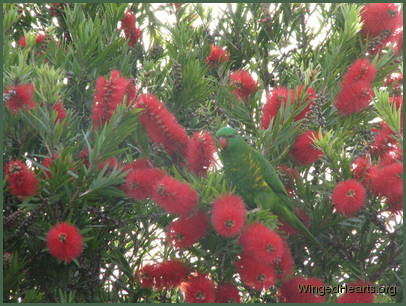
scaly-breasted lorikeet In order to understand birds, one has to pay attention with both ones ears and eyes.  In other words we need to hear  the sounds they are making while also following their actions. I call this 'Listening With Your Eyes'.

Birds love chattering and sharing the days news with each other.  Every bird species has its own language. The different species don't have much difficulty following each other.  The birds also have a range of soft almost inaudible 'mm', 'bb' type sounds and a lot of their communication is also non-verbal. read more »

7 Tips to Get To Know Your Wild Birds - Part 2


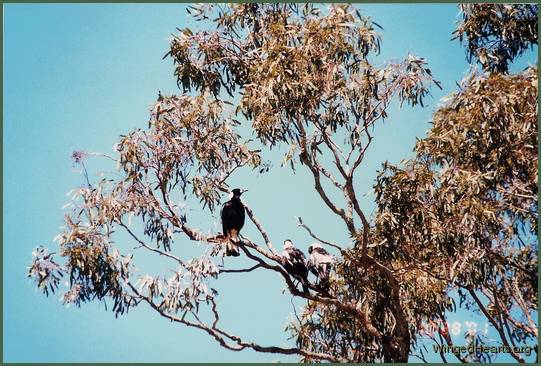
This is one of the first pictures I took of our birds back in 2001 with a film camera. (Any one remember those things that had to be handled carefully and in the dark?)

Molly magpie teaching Maggie magpie and Cindy magpie to sing

Here sitting on an old gum tree is Molly the mother magpie teaching juvis Maggie and Cindy to sing.  They had the most brilliant voices and loved singing at top volume.  This was during my early days of friendship with them. 

In today's post we will explore tips 4-7 of getting to know your wild birds. read more »

Attract Birds To Your Place and keep them Coming - Part 2

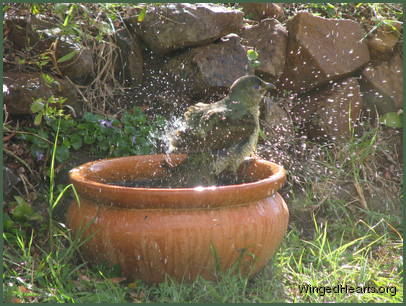
bowerbird at the water bathOnce some birds notice your bird bath or water bowl, they'll spread the word very quickly and other birds will also try it out. 

There are a few things you must do to keep them coming:

1. Clean the bird bath and refresh the water daily: if you can, if not, then every second day.  A bristle brush is ideal to scrub the sides, followed by a rinse with fresh water.  This is a necessary step, or else water will get stagnant, even mouldy, certainly filthy and eventually become a source of disease.

if you have placed a big stone or rock in the middle of the bowl to stop it from tipping over, you may find that this will get mouldy over time.  When that happens its best to have a couple of stones, and use them alternately, that gives each one the chance to dry out before being used again.

If the bird bath is not cleaned and refreshed regularly, the birds will stop coming as this will no longer be a viable drinking spot for them.

2. Observe Your Visitors:  Make a note of which birds have started to visit your place.  Are they able to drink comfortably?   read more »
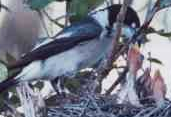
Maggie magpie and Minnie noisy-miner Keep Me Safe From A Snake

Our birds have rescued us from snakes on many occasions.  Magpies, butcherbirds (both the pied and grey species), noisy-miners and others have all played a part at one time or another in keeping us safe.  Most of the time we do not have a camera in hand to capture a photographic record of the event.  But on a few occasions we have been lucky enough to be able to do so.   read more »

My New White-backed Magpie Friends

by Shirley Oelman

I have magpies that visit every now and then and would like to talk about them. 


They first came calling regularly in late July 2009.

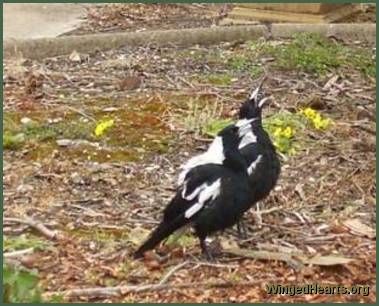
 warbling magpies

  17Oct 09, 10:01am  Warbling so beautiful      


At first I ignored them, then, as they seemed so insistent I went out outside to check out the noise.

There were 5 to start with and the numbers dwindled to 2 from November. I threw out onto the ground minced steak, multi grain bread and some varieties of fruit & veg, plus crushed up biscuits. There is always 2 lots of water for them. One of the magpies loved grapes. The other one would not touch them. If I ignored their call one would come up to my front door and call, then stand and wait looking at the door. When I stepped out it (the darker, taller one) ran away a short distance until I called it and dropped food and then it came within 4 foot of me and ate. The light grey one always kept back and never came too close.

 
 read more »

Spare The Cockatoos A Life Sentence


Caged cockatoos often suffer greatly and end up leading a life time of misery. caged-ckatoo

Wildlife carers Peter Richards and Gabrielle Friebe from the Long Grass Nature Refuge have rehabilitated cockatoos for over seven years (as well as many other species for 35 years).  In the interview below they explain the plight of the pet cockatoo and what one should do to give them a quality of life.

(To receive a free copy of  full article you can subscribe to the Wild Bird Talking ezine by entering your details in the box  on top of the left hand column.)    

In this interview you will learn about: 

-  the physical and emotional problems faced by pet cockatoos in cages   

-  the needs of pet cockatoos so they can have a more natural life   

-  essential ways in which to give pet cockatoos a quality of life   

-  elements of a balanced diet necessary for a healthy bird

-  keys to eliminate personality problems, have a better relatioship with your companion bird and a good friendship.


You can listen to the audio and view the pictures below. read more »

Theme provided by Danetsoft under GPL license from Danang Probo Sayekti